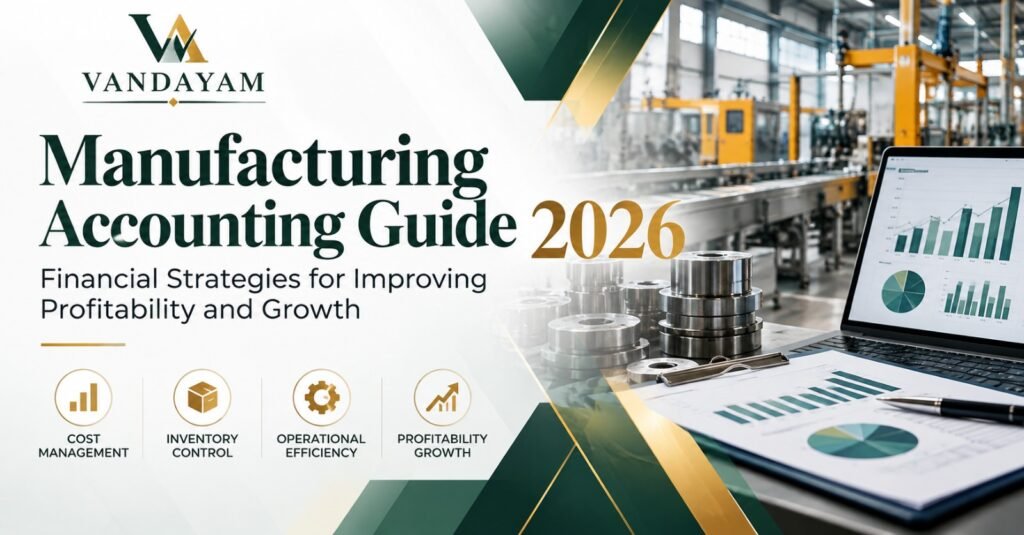

Manufacturing Accounting Guide 2026: Financial Strategies for Improving Profitability and Growth
October 2, 2026
Businesses reaching the $1 million in annual revenue is a significant milestone for any business. It represents validation of your product, service, market demand, and business model. However, crossing the $1 million revenue mark also face a new set of financial challenges that few are prepared to face.
The strategies that allowed a business to scale from the garage to $1 million are oftentimes insufficient to scale further. In spite of the increase in revenue, businesses begin to face growing pains associated with staffing, cash, complexity, compliance, cost, and risk.
Oftentimes businesses assume higher revenues equal higher profits, but businesses crossing the $1 million revenue threshold frequently find themselves under greater strains on cash, profits, and complexity that can stifle their growth.
At this inflection point a business requires a financial steward to help it navigate the challenges ahead.
Whether in house or outsourced, a Chief Financial Officer (CFO) is an invaluable resource to help a business scale beyond the $1 million revenue barrier. This playbook serves as a guide for business owners looking to get the right financial leadership in place to help them cross the $1 million revenue threshold and continue to thrive in the years to come.
Businesses should consider the following financial strategies, systems, and leadership guidance when crossing the $1 million revenue threshold and preparing to scale further.
Why $1 Million Revenue Matters
Many business owners believe the hardest part of building a business is getting to $1 million in sales.
However, the opposite is true. Once a business crosses the $1 million revenue barrier, it faces a number of unique challenges that few are prepared to face. At this inflection point, businesses face:
- Larger teams
- Increased expenses
- Greater complexity
- Increased compliance risk
- Higher customer expectations
- More intense competition
The business owner is no longer able to simply rely on spreadsheets, intuition, and bookkeeping to help them run their business. The company requires:
- Financial forecasting
- Cash flow management
- Strategic budgeting
- Performance analysis
- And profitability guidance
Without these systems and the leadership to implement them a business can grow faster than its ability to manage.
The Biggest Mistake Businesses Make After Crossing $1 Million
One of the biggest mistakes businesses make after crossing the $1 million revenue barrier is believing that growth equals success. Many businesses wrongly fixate on revenue while ignoring the warning signs that their profits are being eroded. The business owner has moved onto a new level, but they must understand the financial intricacies that come with it. While many businesses can take pride in announcing that they’ve achieved $1 million in sales, many fail to acknowledge that they were only barely profitable. A business generating $1.5 million in revenue with weak margins may be less financially stable than a business generating $800,000 in revenue could be significantly more profitable, but it failed to recognize that change was required. At this stage, the CFO mindset is to look at what drives profitability, rather than what drives revenue.
Step 1: Build Financial Visibility
One of the first priorities of any business crossing the $1 million revenue barrier is to develop financial visibility. Many businesses that are growing quickly find themselves without proper financial reporting in place. Many owners have a general understanding of their business’s financial health, but lack detailed insight into their:
- Profitability by customer
- Profitability by product
- Departmental performance
- Cost trends
- Cash flow drivers
The CFO is responsible for establishing the financial visibility and reporting systems necessary to understand a business’s financial health. Key reports include:
Profit and Loss Statement
Tracks:
- Revenue
- Cost of goods sold
- Operating expenses
- Net profit
- Balance Sheet
- Provides visibility into:
- Assets
- Liabilities
- Equity
- Cash Flow Statement
- Shows:
- Cash inflows
- Cash outflows
- Liquidity position
These reports become invaluable in helping a business develop a financial strategy to help it thrive at the next level.
Step 2: Focus on Cash Flow, Not Just Profit
One of the most important lessons learned when scaling a business is that cash flow and profit are not the same thing. Even a profitable business can find itself in dire straits if it suffers from cash flow challenges. Some common cash flow pitfalls include:
- Customers taking too long to pay
- Inventory buildup
- Large capital expenditures
- Rapid increases in staffing
- A CFO is vital in helping a business understand its:
- Accounts receivable
- Accounts payable
- Inventory management
- Working capital needs
Cash forecasting becomes an essential tool for any business trying to scale. Businesses should always understand their cash position at:
- 30-day cash flow forecast
- 60-day cash flow forecast
- 90-day cash flow forecast
This information is invaluable in helping a business understand its liquidity position.
Step 3: Establish a Strategic Budget
Many businesses do not establish a formal annual budget when they begin to scale. Instead, many are reactive when it comes to budgeting and forecasting. As a business grows, this approach can become increasingly perilous. A CFO can help establish a strategic budget that helps a business reach its strategic goals. An effective budget helps a business:
- Control spending
- Understand its financial position
- Grow intelligently
- Operate profitably
- A strategic budget should consider:
- Revenue targets
- Expense management
- Staffing requirements
- Marketing budgets
- Capital expenditures
- The right budget provides a valuable roadmap for a growing business.
Step 4: Identify Profitability Drivers
Not all customers, products, and sales channels are created equal. Many businesses fail to optimize by assuming every customer and channel is a profit center. However, many customers and channels burn cash instead of generating it. A CFO will examine a business’s:
- Customer profitability
- Product profitability
- Channel profitability
- Departmental profitability
Once a business understands what drives profitability it can make smarter decisions about its time, money, and resources.
Step 5: Create Financial KPIs
Once a business reaches $1 million in revenue it should begin to think strategically about its financial KPIs. KPIs allow a business to measure its financial performance in an objective way. Important financial KPIs include:
- Gross profit margin
- Net profit margin
- Customer acquisition cost
- Customer lifetime value
- Accounts receivable days
- Cash conversion cycle
- Revenue per employee
Tracking these KPIs can provide valuable insight into a business’s financial health.
Step 6: Build a Scalable Financial Infrastructure
Many businesses reach $1 million in revenue before realizing that their financial infrastructure is inadequate. Common signs that a business needs to upgrade its financial infrastructure include:
- Overreliance on spreadsheets
- Manual reporting processes
- Inconsistent financial data
- Inconsistent financial reporting
A CFO can help build and implement a more scalable financial infrastructure, including:
- Cloud accounting systems
- Financial dashboards
- Financial reporting automation
And more
Modern financial infrastructure is an essential enabler for any business looking to scale beyond $1 million in revenue.
Step 7: Prepare for Hiring and Team Growth
Staffing costs are typically one of the largest expenses for any growing business. However, many businesses fail to make intelligent hiring decisions when they grow. A CFO can help a business evaluate:
- Labor cost ratios
- Productivity metrics
- Workforce planning
- Compensation strategies
Many business owners ask themselves questions like:
Can we afford to hire more people?
Will the new hires improve profitability?
How much will the new hires cost?
Adequate planning is essential prior to any major workforce increases.
Step 8: Strengthen Risk Management
As a business grows, the potential for risk also increases. Some common risk factors include:
- Customer concentration
- Economic downturns
- Cash flow challenges
- Vendor concentration
- Compliance risk
A CFO can help a business develop an appropriate risk management framework that helps it mitigate these concerns.
Step 9: Develop a Growth Financing Strategy
Many businesses need to raise additional capital to help fund their growth. Some common uses of capital include:
- Expansion
- Equipment purchases
- Hiring
- Marketing
- Acquisitions
A CFO can help a business develop a financing strategy to help fund its growth.
Step 10: Shift from Operator to CEO
Many successful business owners continue to spend too much time on the operational side of their business, instead of investing their time in higher level strategic initiatives. A CFO can help a business owner develop the systems and processes needed to free up their time, allowing them to focus on issues like:
- Company vision
- Strategic planning
- CEO-level responsibilities
- Financial leadership can be an essential enabler for any business looking to scale.
- The Benefits of Fractional CFO Services
Many businesses looking to scale to $1 million in revenue do not require a full-time CFO. Instead, many benefit from the leadership and expertise of a fractional or outsourced CFO. Some of the key benefits of outsourced CFO services include:
- Cost efficiency
- Financial expertise
- Immediate impact
- Scalability
Outsourced CFO services can be an ideal solution for many growing companies.
Common Financial Red Flags at the $1 Million Stage
Business owners should look out for the following financial red flags at the $1 million revenue stage:
- Declining profit margins
- Decreasing cash flow
- Increasing debt
- Delayed or inaccurate financial reporting
- Customer concentration
- Rising expenses
- Increased employee turnover
These red flags can be an early warning sign that a business owner would benefit from the services of a CFO.
What High-Growth Businesses Do Differently
Many high-growth businesses share several similarities when it comes to financial management. Some of the most common characteristics of high-growth financial management include:
- Monitoring KPIs
- Forecasting cash flow
- Reviewing P&L statements monthly
- Adopting new technology
- Focusing on profitability
- Implementing strong internal controls
- Making decisions based on data
Conclusion
Crossing the $1 million revenue threshold can be both exciting and intimidating. While $1 million in revenue is certainly a major accomplishment, many businesses find themselves at a new inflection point in their growth trajectory. The strategies that many businesses used to get to $1 million simply aren’t sufficient to get them to $2 million or $5 million. However, those that do continue to thrive recognize the importance of developing financial visibility, ensuring adequate cash flow management, examining profitability drivers, developing strategic budgets, and strengthening their risk management frameworks. At Vandayam, we offer outsourced CFO services, financial planning and analysis, accounting, and advisory services helping companies scale and optimize their financial management systems. Our team is here to help your business thrive and grow.